Essential Kitchen Knives and Cutting Boards
A compact, well-maintained setup is more useful than a crowded knife block and makes everyday prep calmer and safer.
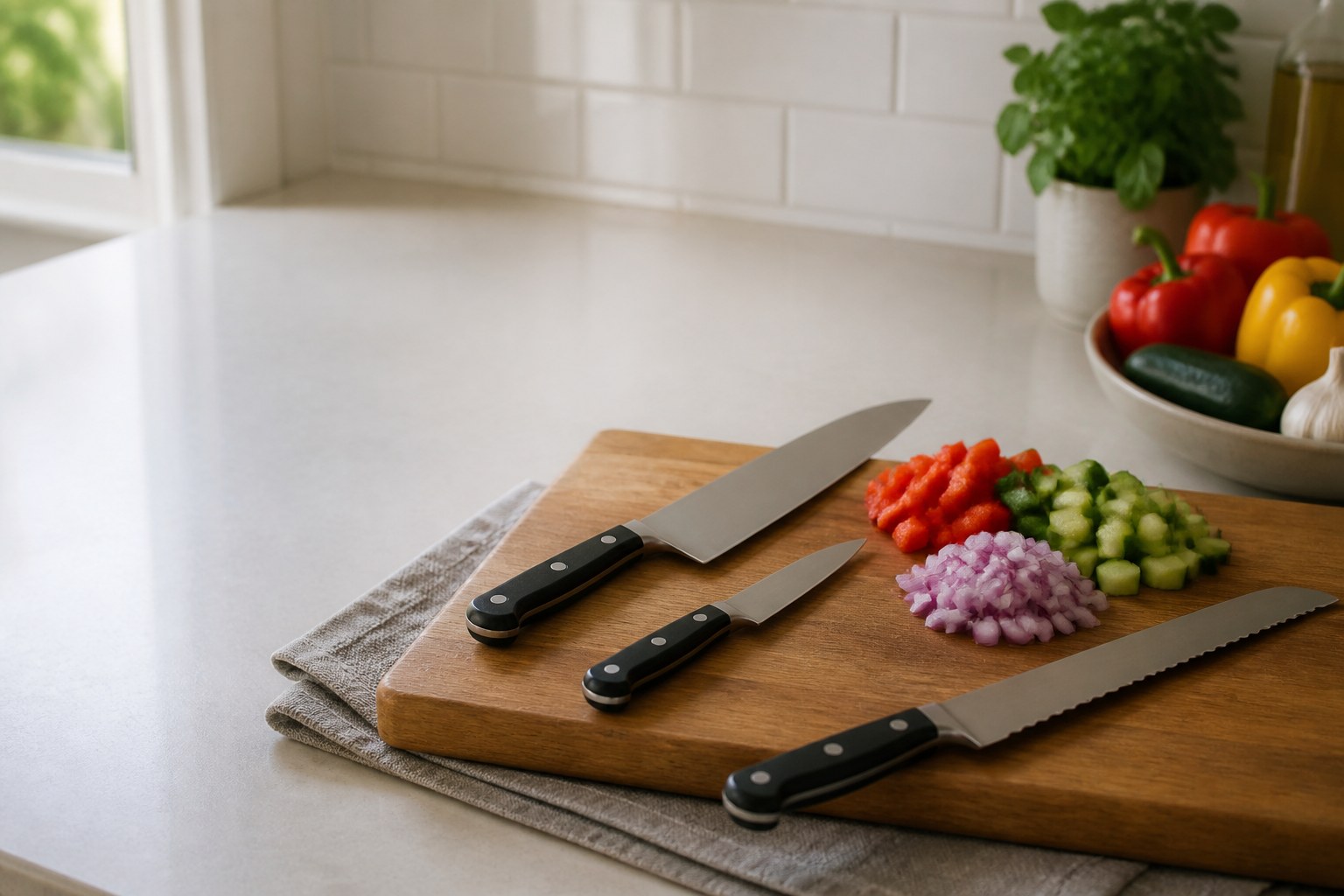
Start with three useful shapes
A chef's knife handles most chopping, slicing, and mincing. A paring knife gives control for trimming and small hand-held tasks. A serrated bread knife moves through crusty loaves, ripe tomatoes, and delicate cakes without requiring downward pressure. Add a specialty blade only when a repeated task genuinely calls for it.
Fit matters more than prestige
The handle should feel secure without forcing your wrist into an awkward angle. Check that you can pinch the blade near the handle comfortably and that the knife is neither so heavy it tires you nor so light it feels unstable. A modest knife that fits your hand and stays sharp is more useful than an expensive one that does not.
Choose a board that stays put
Wood and quality plastic boards are both practical when kept clean, dry, and free of deep damage. The board should be large enough to hold the food and the growing pile of cut ingredients. Place a damp towel or nonslip mat beneath a sliding board; stability is part of knife safety.
Separate, wash, and replace
Use a dedicated board or a careful cleaning sequence when working with raw meat, poultry, or seafood. Wash boards according to their material and let them dry fully before storage. Replace plastic boards with deep grooves that trap residue and wooden boards that split or cannot be cleaned effectively.
Keep the edge working
A honing rod can realign an edge between sharpenings, but it does not replace actual sharpening. Use a stable sharpener suited to your knife or have the blade serviced. Store knives in a block, on a secure magnetic strip, or in blade guards rather than loose in a drawer.